
From Cost Center to Profit Driver: The Asset Utilization Shift
The Essential Role of Industrial Asset Utilization in Driving Profitability
Most digital transformation initiatives still struggle to succeed, with some researchers citing as much of 70% of initiatives failing to scale. At the same time on-the-ground operators and engineers continue to waste much of their week on manual data entry instead of focusing on making more with less.
The disconnect lies in an organization’s ability to leverage effective industrial asset utilization and interoperability to drive revenue generation efforts. With the rapid advancement of technology and rising disruption, industrial companies in sectors like manufacturing and energy are increasingly focusing on ensuring that different systems and equipment within their operations can seamlessly work together. This approach not only enhances operational efficiency but also significantly boosts profitability.

How Asset Utilization Drives Profits
Asset utilization refers to the effective use of a company's physical and technological resources, such as machinery, equipment, and production facilities. Maximizing asset utilization ensures that resources are not only operational but at full potential. Efficient use of assets reduces capital expenditures, freeing companies to achieve more output without the need for additional investments in new equipment or facilities.
Improved asset utilization also instills responsive production, which means companies can react to market forces more quickly. By producing exactly what is needed - at the right time - companies cut excess in inventory levels and reduce holding costs.
For example, by implementing better practices in maintenance, scheduling, and production processes, companies enhance asset utilization, resulting in machinery that better meets changing demand and bounces back faster from changes to cost and inventory. Techniques such as predictive maintenance help preemptively address issues before they cause downtime, ensuring that machinery is consistently operational, and output is maximized.
In today’s world, we have learned that effective integrators of innovation are often laser focused on the quality of data they receive. Even with the obsession that many companies have regarding data quality, Babbage’s garbage in, garbage out paradox seems more appropriate than ever given the current artificial intelligence (AI) boom. The reason for this is because for AI to be hugely successful in helping companies meet their desired outcomes, data practitioners and operational leaders must determine what defines some data as high quality and other data sets as pure garbage. Only high-quality data and relevant information should ever be fed into AI engines.
Achieving effective integration of AI and getting as much value as possible from this innovative investment requires a lot more attention to the journey or lifecycle of data and data management - going past the need to simply seek clean, accurate and timely data points to ones that add context and interoperability to the data elements. For asset intensive companies looking to lead with AI in 2026 data contextualization, AI interoperability is a crucial and complex element to achieve that requires the following key steps.
Interoperability
Interoperability refers to the ability of different systems and equipment to work together within an industrial environment. As industries adopt increasingly complex technologies, ensuring interoperability becomes paramount. Systems that can communicate and work together effectively can streamline operations, reduce error rates, and enhance decision-making processes.
For instance, in a smart factory environment, machine-to-machine communication can lead to more effective production scheduling, real-time monitoring of performance metrics, and faster response times to unexpected issues. This interconnectedness minimizes idle time and maximizes the use of existing assets, leading to a more efficient operation. Companies that embrace interoperability can gather and analyze data from various sources, allowing them to make informed decisions that positively impact profitability.
Moreover, interoperability facilitates collaboration across different departments and stakeholders, enhancing overall supply chain management. When different parts of an organization, from procurement to production to distribution, can share information seamlessly, companies can optimize inventory levels and reduce costs. This reduction in costs translates directly into increased margins and, consequently, higher revenue.
Driving Revenue
The synergy of asset utilization and interoperability not only enhances operational capabilities but also drives revenue growth. Companies that prioritize these areas can respond swiftly to market changes, tailor their offerings to meet customer demand, and leverage their resources more effectively. Enhanced asset utilization ensures that a company can produce efficiently, while interoperability enables agile operations that can scale and adapt to varying demand scenarios.
In conclusion, industrial asset utilization and interoperability are instrumental in driving revenue for businesses. By maximizing the use of resources and ensuring systems work cohesively, organizations can optimize their operations, reduce costs, and meet market demands effectively. As industries evolve, those that embrace these principles will be well-positioned to achieve sustainable growth and increased profitability.
Have You Registered for RUSH 2026 in North America?
Empowering the Next Digital Era with Resiliency & Interoperability.
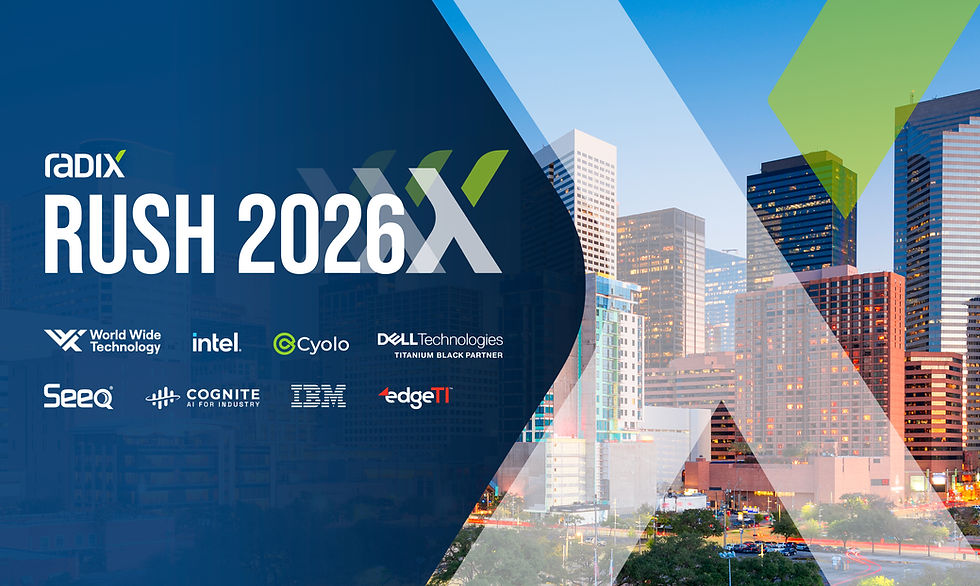
Join industry leaders in Houston for Radix RUSH 2026 — an exclusive event focused on interoperability, industrial AI, and operational performance.
RUSH will also take place in EMEA, delivering localized industry conversations with a shared global perspective.
Secure your seat in Houston today.
About Radix
Founded in 2010, Radix is a privately held technology solutions and services company operating globally, empowering customers with consulting, engineering, operations technology, and digital solutions. Radix combines key capabilities and practices to enable our worldwide customers to thrive in their technology journey. With North American headquarters in Houston, TX, and headquarters in Rio de Janeiro, Brazil, including offices in São Paulo and Belo Horizonte, Radix provides technology-based, data-driven solutions to asset-intensive industries. Radix's robust capabilities extend to more than 30 countries worldwide. Learn more: www.radixeng.com
Do you want to stay connected with Radix?
Subscribe with us today.



Comments